
Wings are the item on a poultry order that punishes bad planning the fastest. Demand jumps on a calendar everybody can see coming, the quote moves with it, and the piece count in a case depends on a size grade that two distributors will describe with two different words. This guide is for the operator buying wings by the 40-pound case in New York: what party wings actually are, how to count pieces per case, how to compare wings against other cuts on cost per plate, and how to handle the cold chain so you are not throwing away product you already paid for.
Buyer guide
Chicken Wings Wholesale NYC
Buying chicken wings wholesale in NYC: party wing specs, how many pieces are in a 40 lb case, why the wing market moves, and cold-chain handling.
How many wings are in a 40-pound case?
There is no single number, because wings are sold by weight and graded by piece size. Do the arithmetic instead: a 40-pound case is 640 ounces, so at roughly 1.5 ounces a segment you land near 420 pieces, and at a heavier 2-ounce segment you land closer to 320. That spread of 100 pieces per case is the whole reason you confirm the size grade on the quote before you cost a plate. Ask what the pack is described as on the invoice spec and keep that description on file, because comparing one supplier's case against another's only works when the piece size matches.
- 40 lb case = 640 oz of product to divide
- At about 1.5 oz per segment: roughly 420 pieces per case
- At about 2 oz per segment: roughly 320 pieces per case
- Confirm the size grade on the day's quote; it changes the piece count more than anything else
- Cost your plate on pieces per case, not on pounds per case
What are party wings and how are they different from whole wings?
Party wings arrive already separated into drumettes and flats with the tip removed, so they are ready to batter, fry or sauce straight out of the bag. A whole wing is one piece with three joints, and your cook has to break it down before service, which costs labor and leaves you holding tips that most menus do not sell. For a kitchen that runs wings as a volume item, the party cut usually wins on labor even if the price per pound reads higher; for a kitchen that sells a whole-wing plate, the whole wing is the only honest spec. The one thing not to assume is that both packs give you the same number of servable pieces per pound.
- Party wings: drumettes and flats, tip removed, no breakdown needed
- Whole wings: three joints per piece, tips included, prep labor required
- Party cut saves line time on batter and fry stations
- Whole wings only make sense if the menu sells the whole wing
- Mixing the two in one week wrecks your piece count and your plate cost
Why does the wing price move more than other cuts?
Because wings are driven by demand on a calendar, not by how many birds get processed. Every bird has two wings no matter how the rest of the market behaves, so when football season, playoff weekends and big-game Sundays pull everybody toward the same cut at the same time, the quote reflects it. That is why no price appears on this page: wings are quoted the day you order and the number is a market number, not a list number. The practical move is to ask for the day's quote, ask whether the quote is per pound or per case, and set your menu price with the knowledge that your cost will not sit still for a quarter.
Cost per usable pound: how wings compare with other cuts
Wings lose more of their weight to bone and skin than any boneless cut, so comparing wings to boneless breast on price per pound tells you almost nothing. Compare on cost per servable piece and cost per plate. A 40-pound case of party wings gives you a known piece count and almost no trim, which is the advantage; what it does not give you is yield flexibility, because you cannot portion a wing smaller when the market jumps. Boneless cuts behave the opposite way: more trim work, but you control the portion to the ounce.
- Wings: no trim decisions, fixed-ish piece count, no portion flexibility
- Boneless breast: trim labor, but the portion is yours to set
- Drumsticks: bone-in like wings, usually a heavier piece for the same plate footprint
- Compare suppliers on cost per servable piece, not on cost per pound
- Recost the plate whenever the size grade on the invoice changes
How do I spec a wing order with my distributor?
Put the spec in writing once and read it back on every order. The fields that matter are the cut, the size grade, the case weight, whether the pack is frozen or fresh, and what you will accept as a substitute if your grade is short that week. Saying it out loud at order time takes thirty seconds and prevents the most common wing problem in a kitchen, which is a case that is technically correct and useless for your plate.
- Cut: party wings or whole wings, stated plainly
- Size grade as it appears on the invoice spec
- Case weight and how many cases you want
- Frozen or fresh, and whether the pack is loose or in inner bags
- Your substitution rule in writing, so nobody improvises for you
- Route day and the order minimum, both confirmed by the salesperson
Cold chain: receiving, storing and thawing a wing case
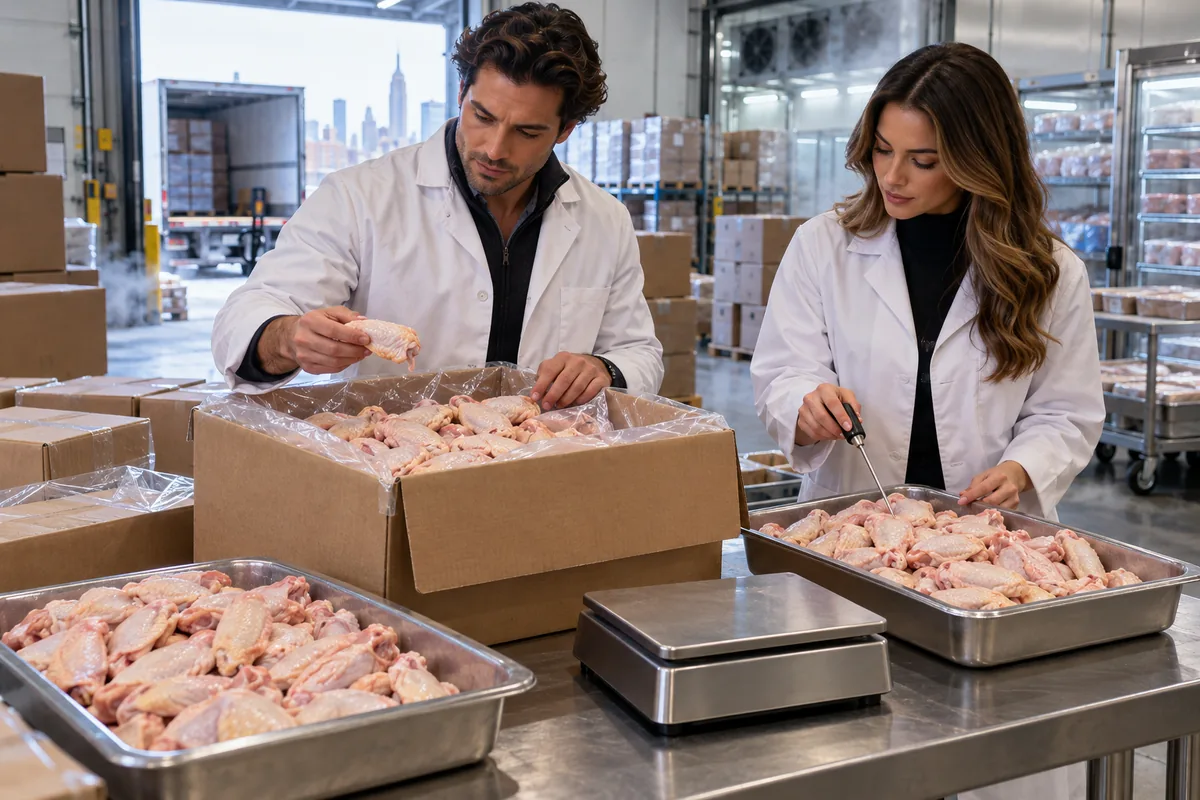
Hold frozen wings at 0 °F (-18 °C) and thaw in the cooler at 40 °F or below, never on a counter or in standing warm water. Cook poultry to 165 °F internal, measured in the thickest part of a piece, which is the USDA figure and the one your staff should know without looking it up. FSIS guidance allows refreezing product that thawed in the refrigerator, with some quality loss, but a wing that has been thawed and refrozen fries differently, so thaw to the day's count instead of to the case. Check the case at the door: hard-frozen, carton dry and square, no heavy ice inside the bag, and the count matching the invoice before you sign.
- Freezer: 0 °F (-18 °C); cooler: 40 °F or below
- Cook poultry to 165 °F internal, verified with a thermometer
- Thaw in the cooler on a tray, on a low shelf, never on the counter
- FSIS reference: perishable food above 40 °F for two hours or more should be discarded
- Note shortages and damage on the delivery ticket while the driver is there
When should a wing menu lean on drumsticks instead?
When the wing quote moves faster than your menu can. A drumstick is bone-in, takes the same batter and the same sauce, and gives you a heavier piece per plate, so a fried-chicken basket built on small drumsticks can hold a price point through a week when wings spike. This is not a swap you make silently on a wing order, since a customer ordering wings expects wings; it is a second item on the menu that lets you keep selling fried chicken when the wing number does not work. Keep both specs quoted so you can decide with real numbers instead of guessing.
Ordering wings across New York State
The delivery route covers all of New York State, so wings can ride with the rest of your poultry order instead of becoming a separate trip to a market. Order minimums and the delivery window for your zone are confirmed by the salesperson when you place the order, and availability of a given cut or size grade is confirmed the same way, because no distributor can promise a demand-driven cut will be sitting there every week of the year. If wings are a core item for you, the useful habits are simple: keep a freezer par that covers your busiest two days, get the quote early in the week rather than the morning you need product, and keep a second cut on the menu that can carry the station if the grade you want is short.
How far ahead should you order wings for a big game weekend?
Place the order before the demand week, not during it. Wing demand in New York spikes around the football playoffs, the Super Bowl and March Madness, and that is exactly when the market tightens and allocations get tight across the trade. Call your salesperson earlier than your normal day, confirm what is actually available for that week, and get the cases in the freezer while there is still freezer space to put them in. Nobody can promise you a case on Friday afternoon for a Sunday rush, and planning as if they can is how a wing special turns into an apology.
- Work backwards from the demand date, not from your usual order day
- Confirm availability for that specific week, in writing if you can
- Check freezer space before you commit to extra cases
- Decide the backup cut in advance and price it the same week
- Tell the kitchen the par level for the weekend, not just the order
- Agree with the salesperson on who calls whom if something comes short
What is your backup when wings come up short?
Have one chosen before you need it. The rest of the bird rarely spikes with the wing, so the normal substitutes are already in the catalog and already in your cooler rotation. The trick is to decide the swap while you are calm and to write the menu language so it does not promise a cut you may not have.
- Drumsticks: closest eating experience by the piece, holds sauce well
- Whole chicken legs: more meat per piece, better for a plate than a basket
- Boneless leg: cut to strips when you need a fast fry and consistent portions
- Menu wording: 'chicken by the piece' survives a short week, 'jumbo wings' does not
- A second supplier on the books for the one cut you cannot run out of
How do you spec wings so two quotes are comparable?
Name the segment, the size and the pack format, because those three decide the number before anybody talks price. Party wings are segmented into drumette and flat with the tip removed; a whole wing is all three joints together and weighs more per piece. If one supplier quotes party wings and the other quotes whole wings, you are not comparing anything. Then ask about size grade and pieces per case, and about whether the product is individually frozen or frozen as a block, because that changes how you thaw and how much you waste on a slow night.
- Segment: party wings (drumette plus flat) or whole wing
- Size grade, or the expected pieces-per-pound range
- Pack: IQF versus block, and the case weight
- Net weight versus any glaze or added solution
- Frozen or fresh, and the date code policy
- Pieces per case range, so you can cost a basket instead of a pound
What do you check when a wing delivery hits the door?
Check temperature and package integrity before the driver leaves, then count. Frozen wings should be hard, with no soft corners and no heavy ice inside the bag, which is the sign of a thaw and refreeze upstream. As a general reference, USDA/FSIS guidance is 0 °F for frozen storage and 40 °F or below for refrigeration; if what arrives does not match the condition you ordered, document it with a photo and call it in the same day rather than putting it away and arguing about it next week.
- Case count and case weight against the invoice
- Boxes hard, not soft at the corners
- No heavy ice crystals inside the inner bag
- Date codes legible and recorded by delivery
- Cases into the freezer first, paperwork second
- Photo and same-day call on anything that is off
Frequently asked questions
- How many pieces are in a case of party wings?
- It depends on the size grade. A 40-pound case is 640 ounces, so roughly 320 to 430 segments depending on whether the pack runs near 2 ounces or near 1.5 ounces a piece. Confirm the grade on the day's quote and cost your plate from that number.
- What is the difference between party wings and whole wings?
- Party wings come already cut into drumettes and flats with the tip removed, so they go straight to the batter station. Whole wings are one three-joint piece and have to be broken down in house, which adds labor and leaves you with tips.
- What temperature do chicken wings need to reach?
- 165 °F internal, measured in the thickest part of the piece. That is the USDA figure for poultry and it applies whether the wings are fried, baked or smoked.
- Why do you not publish a wing price?
- Wings are quoted the day you order because the wing market is demand-driven and moves with the calendar. Any number printed here would be wrong within days, so ask for the day's quote and whether it is per pound or per case.
- Can I count on the same wing size every week?
- No, and no distributor should promise it. Size grade and availability move with the market, which is why your order spec should include a substitution rule you have agreed to in advance.
- Are party wings the same thing as whole wings?
- No. Party wings are segmented: the drumette and the flat, with the tip removed, so every piece is ready to fry. A whole wing is all three joints attached and weighs more per piece, which changes your piece count and your basket cost even at the same price per pound.
- Do wings move more in price than breast?
- Wings are the most demand-driven cut on the bird, so yes, they tend to swing harder and faster around sports and holiday weekends while other cuts sit still. That is why the number comes from the salesperson on the day you order rather than from a list.
- Can I refreeze a case of wings that arrived soft?
- Do not put it away and decide later. Document the condition, call it in the same day, and follow your own food safety plan on what can be accepted; USDA/FSIS guidance on frozen storage is 0 °F, and product that did not arrive in the condition you ordered is a receiving decision, not a freezer decision.