Almost every case of chicken that reaches a small New York kitchen arrives frozen, and most of the money made or lost on that case is decided before anybody turns on a burner. Whether the pack is individually frozen or a solid block changes how you thaw it. How the case looks at the door changes what you can claim later. How much freezer you have changes what par level is realistic. This guide is about the buying and handling side of frozen chicken at wholesale, written for operators who order by the case.
Buyer guide
Frozen Chicken Wholesale
Frozen chicken wholesale for New York operators: 40 lb case specs, IQF vs block, safe thawing, receiving checks and how frozen poultry is quoted.
What does "frozen chicken wholesale" actually mean?
It means poultry frozen after processing and held cold all the way to your door, sold by the case rather than by the pound. In our catalog the standard unit is a 40-pound case. The part that varies, and the part worth asking about, is the pack format inside that case: individually quick frozen pieces that pour out loose, layer-packed pieces separated by sheets, or a solid block where the whole case freezes as one mass.
The format is not a detail. IQF lets you pull four pounds of wings and put the rest back, which is the difference between a case you can portion daily and a case you have to commit to all at once. A block has to be thawed whole or broken apart with tools, which means planning a day ahead and having somewhere cold to put what you do not use. Before you compare two quotes on the same cut, ask which format each one ships, because they are not the same product to work with.
- IQF: pieces frozen loose and individually, easiest to portion in small amounts
- Layer pack: pieces separated by sheets, partial pulls possible with a little work
- Block or solid pack: the case freezes as one mass and is thawed as one unit
- Case unit here: 40 pounds across the chicken line
- Ask the salesperson which format a given item ships before comparing quotes
Is frozen chicken worth it for a restaurant?
For most small and mid-size operations, yes, because frozen removes the clock. Fresh poultry gives you days; frozen gives you weeks, and that turns a delivery-day problem into a storage-space problem, which is usually easier to solve. It also lets you buy on a week when the market is calmer instead of buying whatever is on the truck the day you ran out.
Where fresh still wins is anywhere the texture is on display and the volume is steady enough that nothing sits. A menu built on grilled breast served plain may notice the difference. A menu of braises, fryer items, stews, rice dishes and marinated cuts generally will not. The more honest test is waste: if you are throwing away fresh product at the end of the week, frozen is already cheaper for you even at the same quoted number, because the number you actually pay is per pound you served, not per pound you received.
How do you thaw a 40-pound case safely?
In the refrigerator, under cold running water, or in the microwave if it goes straight into cooking. Those are the three methods USDA guidance recognizes, and counter thawing at room temperature is not one of them. For a full case, refrigerator thawing is the only realistic option: it needs planning, not equipment. Move the case down a day or more ahead of when you need it and keep your walk-in at 40 °F or below.
Build the thaw into the prep schedule instead of improvising it. A standing rule like "Monday's wings come down Sunday morning" costs nothing and prevents the two failures that actually happen in busy kitchens: a case that is still solid at open, and a case left out overnight because somebody was in a hurry. Thaw on the bottom shelf in a pan that catches drip so nothing lands on produce or ready-to-eat product below. Once thawed, the clock is short — treat it like fresh chicken from that point forward and cook it according to your own health department's requirements. Nothing here is food safety advice or an inspection standard; it is a general reference for planning.
- Refrigerator thaw at 40 °F or below — the only practical method for a full case
- Cold running water for smaller amounts you need the same day
- Microwave only if the product goes directly into cooking
- Never thaw at room temperature on a counter or in a sink of warm water
- Bottom shelf, in a drip pan, below ready-to-eat product
- Write the thaw into the prep schedule rather than deciding it each morning
What should you check before you sign for a frozen delivery?
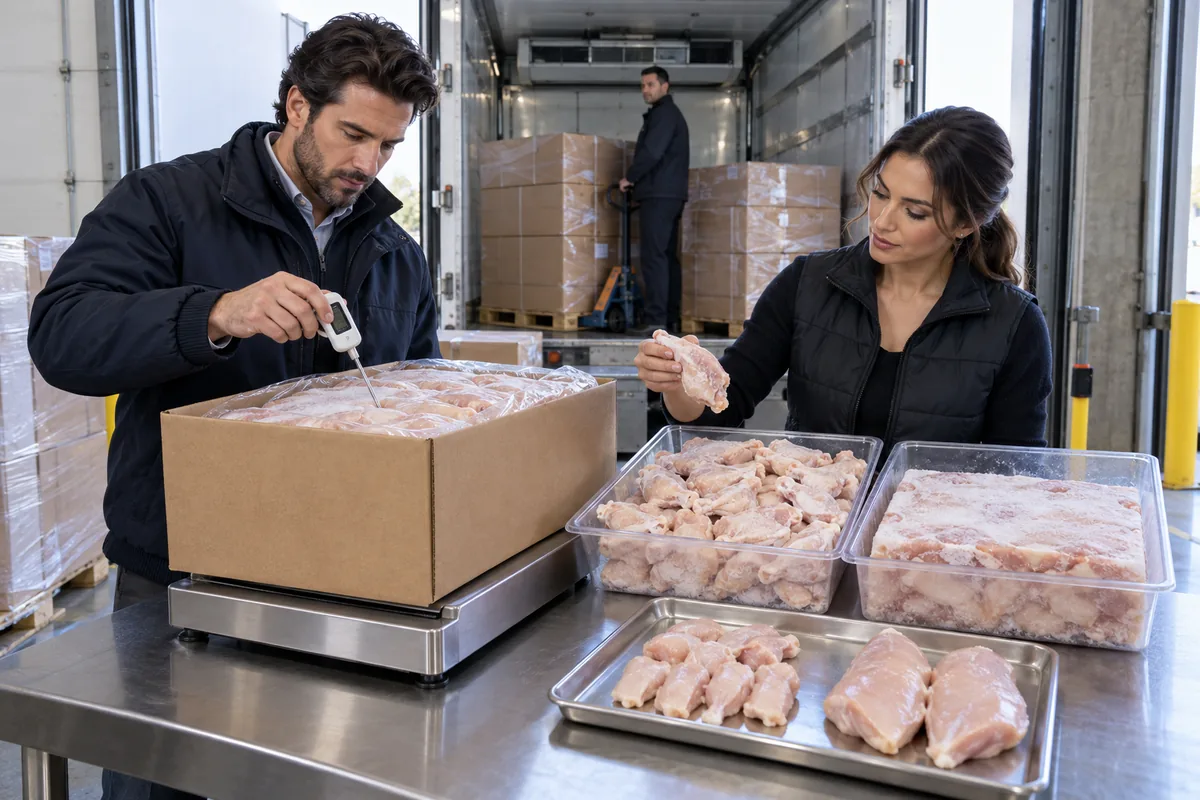
Check the product before the driver leaves, because after the signature the conversation gets much harder. The case should be cold and firm, dry on the outside, square and not crushed. Inside, heavy ice crystals, a frozen puddle at the bottom or pieces fused into a lump in a case that should be IQF all point to the same thing: the load warmed up somewhere and refroze. That product may still be safe, but the quality is gone and you did not order that.
Count the cases against the invoice while you are there, and confirm the cut and the pack match what you ordered — a small drumstick and a medium drumstick are different items with different portion counts, and they look similar through plastic. Anything wrong goes on the delivery ticket in writing, before signing, with the case count and what you saw. Take a photo. That one habit resolves more credit disputes than any phone call afterward.
- Cases cold, firm, dry and not crushed
- No heavy ice crystals, frozen puddles, or pieces fused into a block in an IQF case
- Cut and size match the order, not just the product family
- Case count matches the invoice before you sign
- Write problems on the delivery ticket and photograph them
How is frozen chicken priced and ordered?
By the case, at a number the salesperson gives you the week you order. No price appears on this site by design: chicken is a commodity and the cost changes week to week, so anything printed would be stale. Call for the day's quote, and if you are comparing suppliers, put the two quotes on the same basis before you decide.
Same basis means same case weight, same cut, same size grade and same pack format. A quote on a 40-pound case of party wings and a quote on a 30-pound case of whole wings are not comparable numbers even if they sound close, because the pieces, the count and the usable yield are all different. Ask what the case weighs, how the pieces are packed and what size grade you are getting. Order minimums and the delivery window for your zone are confirmed by the salesperson when you place the order; our route covers all of New York State.
How much freezer space does a case take, and what par should you keep?
Set par from your slowest week, not your best one. The point of a frozen program is to never run out, and the cost of holding one extra case is small compared with the cost of an empty line on a Friday night. Most small kitchens land on one to two weeks of cover on their top two or three items and a single case on everything else.
Space is the constraint that decides this, not appetite. A 40-pound case is a real footprint, and a reach-in fills faster than people expect. Count how many cases your freezer actually holds with the door closing properly, subtract space for anything non-poultry you also carry, and let that number set the ceiling. Then order in a rhythm that matches the route day instead of calling when you notice the shelf is empty, because the case you call about on Thursday afternoon is the case you will not have on Friday.
- Count your real case capacity with the freezer door closing properly
- Par from the slowest week's usage, not the best week's
- One to two weeks of cover on the two or three items you move most
- Single-case par on the long-tail items
- Order on the route rhythm, not when the shelf goes empty
Which cuts hold up best frozen?
Bone-in and skin-on cuts hold up best, because the bone and fat buffer the piece against the drying that causes freezer burn. Wings, drumsticks and whole legs are the most forgiving items in a freezer program and they are also the items most kitchens move fastest, which is a convenient overlap. Gizzards and livers behave well frozen too, but they turn on the plate rather than in the box, so buy them to a tighter par.
Boneless skinless breast is the most exposed item in the case, because there is no skin and no bone shielding the surface. It is still perfectly workable frozen — most of the boneless breast in New York kitchens arrives that way — but it rewards tighter rotation, good wrap and getting it used rather than parked. The general rule across every cut is the same: frozen product stays safe indefinitely at 0 °F, but quality declines with time, so the freezer is a buffer, not a warehouse.
How cold does a walk-in freezer actually need to be?
0 °F (-18 °C) is the working number, and it is a product temperature, not a dial setting. USDA guidance is that food held at 0 °F stays safe indefinitely and what declines is quality, so the point of a freezer log is not to prove safety on paper but to catch a compressor that is slipping before 40 cases of chicken pay for it. Put a thermometer in the warmest part of the box, usually near the door and high, and read it at the same two moments every day so the numbers mean something when you compare them.
- Target product temperature: 0 °F (-18 °C)
- Thermometer in the warmest spot, not next to the evaporator
- Two readings a day, with time and initials, on one clipboard
- Nothing stacked against the coil and nothing blocking the fan
- Cases off the floor, stacked flat, with room for air around the stack
What does freezer burn on a case tell you?
Freezer burn is moisture that left the meat and went into the air, and USDA treats it as a quality defect rather than a safety one: the gray-white dry patches can be trimmed and the rest used. What matters operationally is why it happened. Air reached the product, which means either the packaging was torn or the freezer temperature has been swinging, and a swinging freezer will keep making the problem on every case you put in it. Pull the affected cases forward in the rotation, check your log for a pattern, and tell your salesperson if a case arrived that way instead of developing it in your box.
- Dry gray or white patches: quality loss, trimmable, not a safety recall
- Torn or loose inner bags: fix the packaging or use the case first
- Burn appearing across several cases: check the temperature log, not the product
- Burn present on delivery: note it on the ticket before you sign
What happens to a frozen chicken inventory in a power outage?
Keep the door shut and start timing. FSIS guidance is that a full freezer holds its temperature about 48 hours with the door closed and a half-full one about 24 hours, so a freezer you keep packed is itself a form of insurance. When power returns, judge the product with a thermometer rather than by touch: anything still at 40 °F or below can be refrozen, with some quality loss, and anything that sat above 40 °F for two hours or more should be discarded per FSIS guidance. Write down what you found and what you did, because that record is what a credit conversation or an insurance claim runs on.
- Before: keep the freezer full, know where your thermometer is
- During: door closed, no inventory counts, no case shuffling
- After: read product temperature in several cases, not just one
- Still at 40 °F or below: can be refrozen, expect quality loss
- Above 40 °F for two hours or more: discard, per FSIS guidance
- Document times, temperatures and case counts the same day
How do you run a rotation that staff actually follow?
Make the right case the easiest one to grab. Date every case with a marker the day it is received, keep one zone per week instead of one shelf per item, and load new cases behind the old ones so nobody has to think about it at 6 a.m. A rotation fails for mechanical reasons, almost never because somebody disagrees with it: the oldest case is buried, the marker is dry, or the shelf is so tight that pulling from the front means unstacking four cartons.
- Date the case on arrival, in marker, on a face you can read from the aisle
- New cases go behind, never on top of the open one
- One opened case per item at a time, marked OPEN
- Keep a working marker and a thermometer at the freezer door
- Count the freezer the same day each week so par problems show up early
Is frozen chicken cheaper than fresh at wholesale?
Not automatically. A frozen case and a fresh case of the same cut are quoted separately and both move with the market, so the only fair comparison is cost per usable pound. Frozen chicken loses some liquid as it thaws, so weigh one thawed case before trimming and count that loss in the math.
Frozen wins in other ways: it keeps longer, it lets you buy ahead of a busy week and it covers a missed delivery. Fresh wins when you go through the case in a day or two and have no room or time to thaw 40 pounds safely.
How long can frozen chicken stay in the freezer?
Kept at 0 °F, frozen chicken stays safe indefinitely, according to USDA general guidance; what drops over time is quality. USDA's general reference for best quality is up to 9 months for chicken parts, up to a year for whole chickens and 3 to 4 months for giblets such as gizzards and livers.
Those are reference times, not a promise about any case. Date every case when it goes in, use what came in first and keep the freezer at 0 °F or below. A case that sat on the dock is not the same as one that went straight into the freezer.
Should a bodega or small restaurant buy frozen or fresh chicken?
Buy frozen if a case will take more than a few days to sell or cook, and fresh if it is gone in a day or two. That single question — how fast a 40-pound case moves — settles most of it. The rest comes down to freezer space, thawing room in the walk-in and the menu.
- The case is gone in 1 to 2 days: fresh is usually simpler
- The case takes a week or more: frozen avoids waste
- Little walk-in space for thawing: individually frozen pieces you can pull as needed, or fresh
- Deliveries that do not come every day: frozen as a cushion
- A retail freezer in a bodega: frozen items or sealed bags, like the 1-pound sausage bag
Many operators run both: fresh for the item they sell every day and frozen for everything else.
Frequently asked questions
- How long can you keep frozen chicken?
- USDA guidance is that food held at 0 °F or below stays safe indefinitely, but quality declines with time, so treat the freezer as a buffer rather than storage. In practice, rotate first in, first out, date every case at receiving, and set par so nothing sits long enough for freezer burn to show up.
- What is the difference between IQF and block frozen chicken?
- IQF pieces are frozen individually and pour out loose, so you can pull a few pounds and return the rest. Block or solid pack freezes as one mass and has to be thawed as a unit. IQF is easier to portion daily; block is one commitment per case. Ask which format an item ships before you compare quotes.
- Can you refreeze chicken after thawing it?
- Refreezing is generally discouraged because of what it does to texture and moisture, and it is a common source of the ice crystals you see in a bad case. The safer operating habit is to thaw only what you will use within your normal prep cycle. For what your own operation is required to do, follow your health department's rules — this is a general reference, not an inspection standard.
- How much does a case of frozen chicken cost?
- No price is published here. Chicken is a commodity and the number moves week to week, so the current quote comes from the salesperson at order time. When you call, ask for case weight, cut, size grade and pack format so you can compare quotes on the same basis.
- Can I refreeze chicken that thawed in the cooler?
- FSIS guidance says food thawed in the refrigerator can be refrozen without cooking, with some loss of quality. The condition is that it stayed at 40 °F or below the whole time. Product that warmed past that for two hours or more should be discarded.
- Is freezer-burned chicken safe to use?
- USDA treats freezer burn as a quality issue, not a safety one. The dry patches can be trimmed off and the rest cooked normally. The more useful question is why air reached the product, since that usually points at packaging or at a freezer that is cycling.
- How long can a 40-pound case stay in the freezer?
- At 0 °F, safety is not the limiting factor according to USDA guidance; quality is. Follow the date on the case, your own rotation policy and what your cooks tell you about how the product performs, rather than treating the freezer as open-ended storage.
- How long does frozen chicken last at 0 °F?
- USDA general guidance says food kept at 0 °F stays safe indefinitely. For best quality, it gives up to 9 months for chicken parts, up to a year for whole chickens and 3 to 4 months for giblets.
- Is frozen chicken cheaper than fresh?
- Not by default. Each is quoted separately and moves with the market. Compare cost per usable pound and count the liquid frozen chicken loses as it thaws.
- Does frozen chicken lose weight when it thaws?
- Yes, some liquid comes out as it thaws. Weigh one thawed case of the item before trimming to see how much, and use that number when you compare it with fresh.